
Calculate your estimated due date, current pregnancy week, and key milestones based on your last menstrual period or conception date.
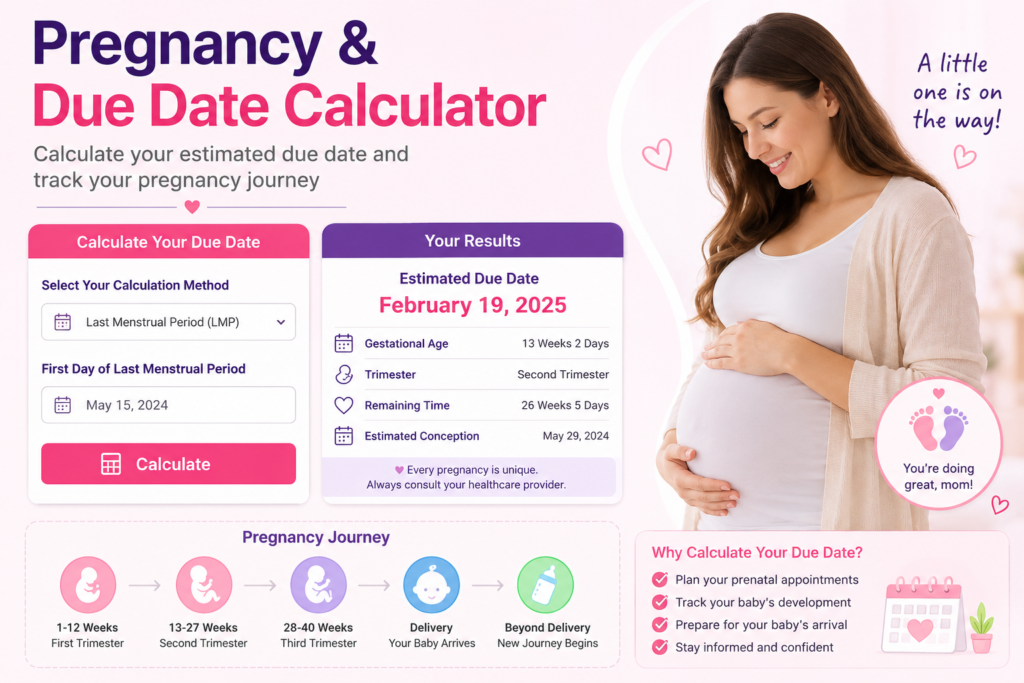
Pregnancy & Due Date Calculator
Pregnancy is one of the most exciting journeys in life, and knowing your estimated due date helps you plan every important milestone. Our Pregnancy & Due Date Calculator provides a simple and accurate way to estimate when your baby is likely to arrive.
By entering the first day of your last menstrual period (LMP), your conception date, IVF transfer date, or your ultrasound date, you can quickly estimate your baby’s due date and follow your pregnancy week by week.
What Is a Pregnancy & Due Date Calculator?
A Pregnancy & Due Date Calculator is an online tool that estimates your baby’s expected birth date based on medical pregnancy calculations.
Healthcare professionals typically calculate pregnancy as lasting:
- 40 weeks
- 280 days
- 9 months and 7 days
from the first day of your last menstrual period (LMP).
Although only about 5% of babies are born on their exact due date, the estimate provides an important timeline for prenatal care and planning.
How Does the Pregnancy Calculator Work?
The calculator estimates your due date using one of several methods:
1. Last Menstrual Period (LMP)
This is the most common method.
If your menstrual cycle is regular (around 28 days), the calculator adds 280 days (40 weeks) to the first day of your last menstrual period.
2. Conception Date
If you know the exact day conception occurred, the calculator adds approximately 266 days (38 weeks).
3. IVF Transfer Date
For IVF pregnancies, due dates are calculated using the embryo transfer date and embryo age.
4. Ultrasound Measurement
Early pregnancy ultrasounds often provide the most accurate estimate when the menstrual cycle is uncertain.
How to Use the Pregnancy & Due Date Calculator
Using the calculator is simple:
- Select your calculation method.
- Enter the required date.
- Click Calculate.
- View your:
- Estimated Due Date
- Current Pregnancy Week
- Current Trimester
- Estimated Conception Date
- Baby Development Timeline
The entire process takes only a few seconds.
Pregnancy Timeline
Pregnancy is divided into three trimesters.
First Trimester (Weeks 1–12)
During this stage:
- Fertilization occurs.
- Baby’s heart begins beating.
- The brain starts developing.
- Arms and legs form.
- Morning sickness is common.
Second Trimester (Weeks 13–27)
This is often considered the most comfortable stage.
During this period:
- The baby grows rapidly.
- Gender may be visible during an ultrasound.
- Baby movements become noticeable.
- Organs continue developing.
Third Trimester (Weeks 28–40)
The final stage prepares both mother and baby for delivery.
Baby experiences:
- Weight gain
- Brain development
- Lung maturation
- Stronger movements
Pregnancy Week-by-Week Highlights
Week 4
A pregnancy test usually becomes positive.
Week 6
Heartbeat can often be detected.
Week 8
Major organs begin forming.
Week 12
Risk of miscarriage decreases significantly.
Week 16
Baby starts making facial expressions.
Week 20
Halfway through pregnancy.
Week 24
Baby develops hearing.
Week 28
Beginning of the third trimester.
Week 32
Baby practices breathing movements.
Week 36
Baby may move into the birth position.
Week 40
The estimated due date arrives.
How Accurate Is the Due Date?
The Pregnancy Due Date Calculator provides an estimate rather than an exact delivery date.
Most babies arrive:
- Between 37 and 42 weeks
- Within two weeks before or after the estimated due date
Factors affecting delivery include:
- First pregnancy
- Mother’s health
- Baby’s growth
- Multiple pregnancies
- Medical conditions
What Is Naegele’s Rule?
Doctors commonly use Naegele’s Rule to calculate the due date.
Formula:
First Day of Last Menstrual Period + 1 Year – 3 Months + 7 Days
This method has been used for many decades and remains one of the standard pregnancy calculations.
Signs Your Due Date Is Approaching
As delivery nears, you may notice:
- Baby dropping lower into the pelvis
- Increased Braxton Hicks contractions
- Cervix beginning to dilate
- Loss of the mucus plug
- Water breaking
- Regular labor contractions
If you experience these symptoms, contact your healthcare provider.
Why Knowing Your Due Date Matters
Your estimated due date helps with:
- Scheduling prenatal appointments
- Monitoring fetal growth
- Planning maternity leave
- Preparing the nursery
- Buying baby essentials
- Monitoring the baby’s development
- Planning hospital delivery
Tips for a Healthy Pregnancy
A healthy lifestyle supports both mother and baby.
Consider these habits:
- Eat a balanced diet.
- Take prenatal vitamins.
- Stay hydrated.
- Exercise with your healthcare provider’s approval.
- Get enough sleep.
- Avoid smoking and alcohol.
- Attend all prenatal checkups.
- Manage stress through relaxation techniques.
Frequently Asked Questions (FAQs)
Can my due date change?
Yes. An early ultrasound may adjust the estimated due date if fetal measurements differ from the LMP estimate.
How many weeks is a normal pregnancy?
A full-term pregnancy typically lasts about 40 weeks from the first day of the last menstrual period.
What if I don’t know my last menstrual period?
Your healthcare provider may estimate your due date using an ultrasound.
Are first babies usually late?
First pregnancies sometimes continue beyond the estimated due date, but every pregnancy is different.
Is the calculator 100% accurate?
No. It provides an estimate. Most babies are born within two weeks before or after the estimated due date.
Can twins have the same due date calculation?
Yes, the initial calculation is similar, but twin pregnancies often deliver earlier than 40 weeks.
Conclusion
Our Pregnancy & Due Date Calculator makes it easy to estimate your baby’s arrival and understand your pregnancy timeline. Whether you’re newly pregnant or tracking your baby’s development week by week, this tool offers a quick and convenient way to stay informed.
Remember that the estimated due date is only a guide. Regular prenatal care and consultations with your healthcare provider are the best ways to ensure a healthy pregnancy for both you and your baby.